
SPC investment planning
What Determines the Cost of an SPC Flooring Production Line?
Understand what affects SPC line investment: extrusion capacity, equipment scope, EIR, finishing, automation and factory setup.
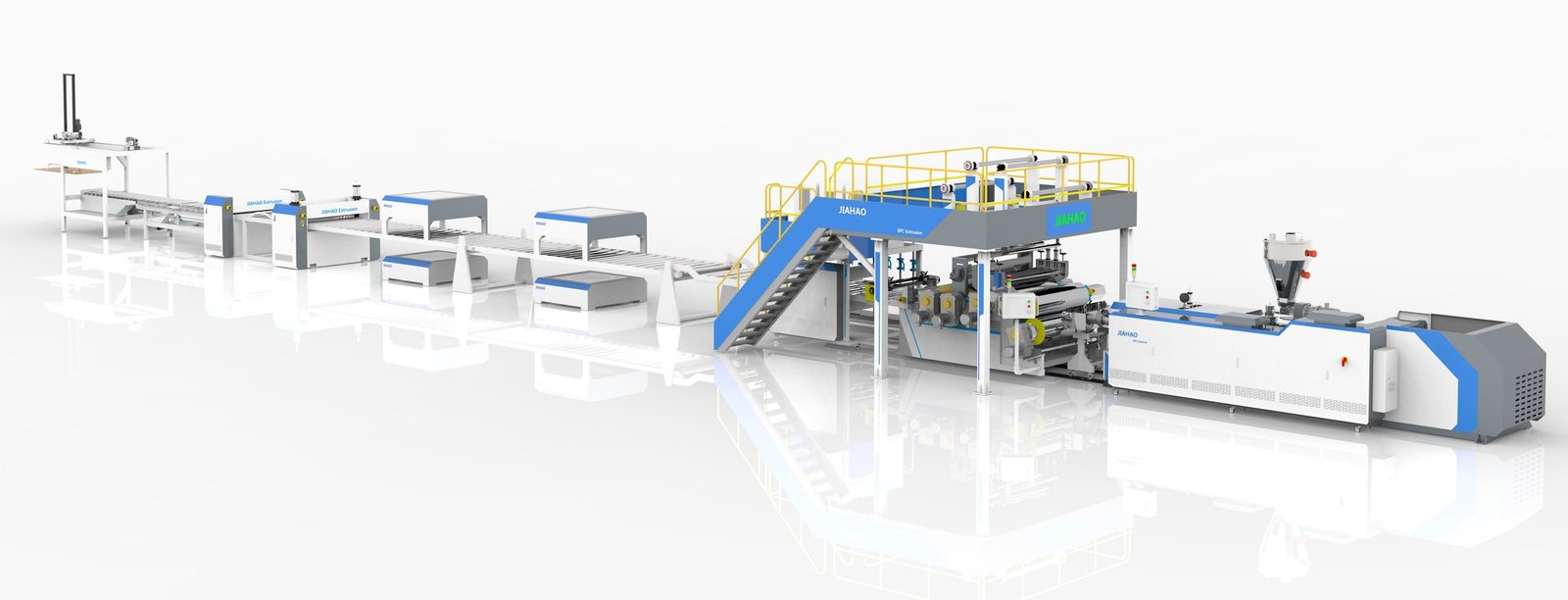
What determines SPC flooring production line cost?
The cost of an SPC flooring production line depends primarily on the equipment included, the required output, the floor construction and surface finish, the level of automation, and the installation scope. An extrusion machine produces the laminated SPC sheet; a complete flooring equipment package also covers material preparation, recycling, UV coating, cutting, click-profile machining, underlay lamination and packing. Comparing those two prices without checking the equipment list can lead to a misleading investment budget.
For manufacturers planning a new SPC flooring factory or expanding an existing operation, the useful starting point is a defined product and process route. Below, we use a Jiahao JHZ110 project proposal and SPC technical presentation to explain how each configuration decision affects the quotation.
1. Equipment scope is the largest difference between quotations
“SPC flooring production line” can describe either the extrusion section or the equipment needed to manufacture packed flooring. In the supplied JHZ110 project proposal, the extrusion section includes a conical twin-screw extruder, T-die, five-roller calender, lamination, roller temperature control, cooling conveyor, trimming, haul-off, shear cutter and automatic stacker.
The wider equipment package adds automatic dosing, hot and cold mixing, scrap recycling, UV coating, slitting and profiling, IXPE underlay lamination and automatic packing. These additional operations explain why a complete project quotation is substantially higher than the extrusion-section price.
| Equipment scope | Included operations |
|---|---|
| Extrusion section | Extruder, T-die, five-roller forming, lamination, cooling, trimming, haul-off, cutting and stacking |
| Broader equipment package | Material preparation, extrusion, recycling, UV coating, slitting, profiling, underlay lamination and packing |
| Optional functions | EIR, selected flipping functions, additional cooling, bevel painting and spare-parts package |
Confirm the selected equipment, optional functions and delivery responsibilities in an itemized proposal. The equipment scope should match your product requirements and existing factory capabilities.
The Jiahao SPC flooring production line page provides an overview of the equipment route. Use that route to mark each operation as newly purchased, already available or supplied separately.
2. Required capacity changes the extrusion and downstream configuration
Higher output requires a suitable extruder and a coordinated forming, cooling and handling arrangement. Jiahao’s SPC presentation lists four extrusion models with the following reference output ranges:
| Extruder model | Reference extrusion output |
|---|---|
| JHZ110/220 | 1,000–1,300 kg/h |
| JHZ115/230 | 1,400–1,700 kg/h |
| JHZ125/235 | 1,900–2,100 kg/h |
| JHZ132 | 2,300–2,600 kg/h |
These figures describe extrusion output in the presentation. They are not guaranteed output of accepted, packed flooring. Actual project performance must be agreed for the intended formulation, board width, thickness and operating conditions.
The JHZ110 proposal separately gives an extrusion-section reference of 2,500–2,700 m² per 24 hours for 5 mm flooring. This should not be compared directly with a daily square-metre figure for a different thickness. A quotation comparison should state both the thickness and the output basis.
Finishing sections also need their own throughput review. A UV or profiling line may have capacity to serve more than one extrusion line, while loading, curing and product changes affect the flow between sections. Review the complete production schedule before selecting each machine solely from its headline capacity.
3. Floor construction and surface effects determine the equipment specification
The supplied materials describe SPC flooring as a layered product with UV coating, a transparent wear layer, a decorative print layer, an SPC core and an optional backing or underlay arrangement. The target thickness, width, layer construction and texture influence the die, forming equipment, film handling and finishing requirements.
Five-roller forming and film lamination
The JHZ110 proposal specifies a five-roller calender with lamination and roller temperature control. The SPC presentation also describes tension control, film deviation correction and laminating rollers. When reviewing a quotation, check which of these functions are included and whether the configuration suits the selected decorative film and wear layer.
Embossed in register
EIR, or embossed in register, aligns the embossed texture with the printed decorative pattern. It adds synchronization equipment and controls. The project proposal identifies EIR as a separate option, so a standard embossed product and an EIR product should be quoted with different equipment scopes.
Bevels and underlay
A painted V-bevel requires an additional edge-painting operation. Underlay lamination adds equipment for bonding IXPE or EVA backing; the presentation describes PUR hot-melt glue for this operation. Decide the intended finished-floor construction before asking for the final equipment price.
4. Cutting, click profiling and finishing are major budget items
Extrusion produces the sheet, but flooring still needs finishing. The JHZ110 proposal lists a precision multi-rip saw, connecting conveyors and double-end tenoners for longitudinal and crosswise click profiling. The profiling package also includes dust collection, handling equipment and specified saw and PCD tooling.
These details matter because a quotation for a basic saw is a different scope from a connected slitting and profiling package. Compare the specified cutting tools, profile requirements, inspection steps, dust extraction and loading or stacking functions.
The supplied proposal states that locking-system patent costs are excluded from its product-cost analysis. Machine capability and any required locking-system licensing should therefore be confirmed separately for the intended product and destination market.
The technical presentation includes curing stages between extrusion, UV coating and later processing. Curing and intermediate storage require space and a handling plan even when they are not presented as one machine on the quotation. For a new factory, include these areas in the workshop layout.
5. Automation, recycling and spare parts affect the investment
Automatic dosing is a distinct equipment package. The JHZ110 proposal includes weighing and conveying for main materials and additives, along with jumbo-bag loading and dust collection. Mixing, discharge, screw loading and silos are listed separately. Confirm these boundaries when comparing a manually supplied line with an automated material-preparation system.
Automation also extends to sheet lifting, flipping, stacking, transfers between machines and final packing. In the project proposal, some functions are standard within a package and others are optional. A written list makes it easier to decide which functions are needed at launch and which can be considered for later expansion.
Scrap recycling requires more than a crusher alone. The proposal includes crushing, milling, loading and silos, while the presentation describes converting production offcuts and rejected sheets into reusable material. Include the recycling equipment and the agreed return-material handling route in the quotation review.
Initial spare parts and tooling deserve their own budget line. The proposal offers a spare-parts package as an option. Ask for its contents and confirm which consumables and wearing parts are covered by the service and warranty terms.
6. Equipment purchase price is only part of the project budget
A complete investment review separates the equipment quotation from transport, factory preparation and commissioning responsibilities. The supplied proposal uses FOB Shanghai terms and lists buyer-side work and services that are outside the equipment delivery scope.
- Transport and destination costs: confirm freight, insurance, import charges and local delivery for the actual destination.
- Factory preparation: identify foundations, installation conditions, cooling water, compressed air and equipment connections.
- Unloading and installation: allocate lifting equipment, local assistance, tools and site access.
- Commissioning and training: confirm engineers’ travel, accommodation and service charges, as well as raw materials needed for trials.
- Initial production support: budget agreed tooling, spares and consumables separately.
The proposal includes training after installation and allocates specified site-service costs to the buyer. Confirm those responsibilities in the current contract. Our factory requirements guide for plastic extrusion lines helps organize the site-preparation discussion.
Keep equipment investment separate from flooring manufacturing cost
Equipment price is a capital investment. Cost per square metre is an operating calculation that depends on resin and additive prices, film and wear-layer specifications, backing, yield, labor, utilities, maintenance and production volume. The two supplied documents use different formulation and product-cost assumptions, so their illustrative totals should not be treated as one universal SPC flooring cost.
Build the operating-cost calculation around the actual target product and local input prices. Installed motor ratings do not establish actual energy consumption per square metre. A useful calculation needs a defined production boundary and product-specific operating data.
What to send when requesting an SPC production line quotation
A clear request helps Jiahao specify an equipment package that matches your production plan. Include:
- Floor sample or drawing, plank dimensions and thickness.
- Wear-layer, decorative film and backing specifications.
- Target output, operating hours and the basis for measuring production.
- Standard embossing or EIR, click profile and bevel requirements.
- Existing preparation, finishing or recycling machines you plan to reuse.
- Required automation, packing method and initial spare-parts scope.
- Workshop layout, site conditions, destination and preferred delivery terms.
Ask for an itemized proposal showing included equipment, options, exclusions and acceptance conditions. Comparing quotations on that basis gives a clearer investment decision than comparing the total price alone.
Contact Jiahao Machinery for an SPC flooring production line quotation. We can review the extrusion model, finishing route and equipment boundary against your product requirements.
Frequently asked questions
How much does an SPC flooring production line cost?
The cost depends on the equipment boundary, capacity, floor construction, finishing requirements and automation level. Request a project-specific quotation based on your target product and the machines you need.
Does an SPC extrusion line include UV coating and click profiling?
Check the equipment list. In the supplied JHZ110 proposal, extrusion, UV coating, and slitting and profiling are separate priced packages. The extrusion-section price does not cover the entire finishing route.
Why does EIR change the quotation?
EIR adds equipment and controls to synchronize the decorative pattern and embossed texture. It is listed as an option in the JHZ110 project proposal.
Can existing finishing equipment reduce the new equipment scope?
Existing equipment can be considered when its dimensions, throughput and process requirements match the new extrusion line. Provide its specifications so interfaces and capacity can be reviewed before removing equipment from the proposal.
Is FOB equipment price the total factory investment?
No. The project budget also needs the agreed transport and destination costs, site preparation, installation services, trial materials and initial production support. Confirm all buyer and supplier responsibilities in writing.
Continue your equipment review
Plan your SPC flooring production project
Share your floor specification, output target and workshop plan for an itemized equipment proposal.