
Process & materials
Why Corrugated Roofing Sheets Are Formed from the Center Out
See how forming rolls shape corrugated roofing sheets from the center out while pulling the warm sheet forward through the line.
The first roll set on a line for plastic corrugated roofing sheets forms two waves in the middle of a wide, flat sheet while the plastic is still warm. Both sides stay flat. The following roll sets add waves to the left and right of that first pair, working outward until the profile is complete.
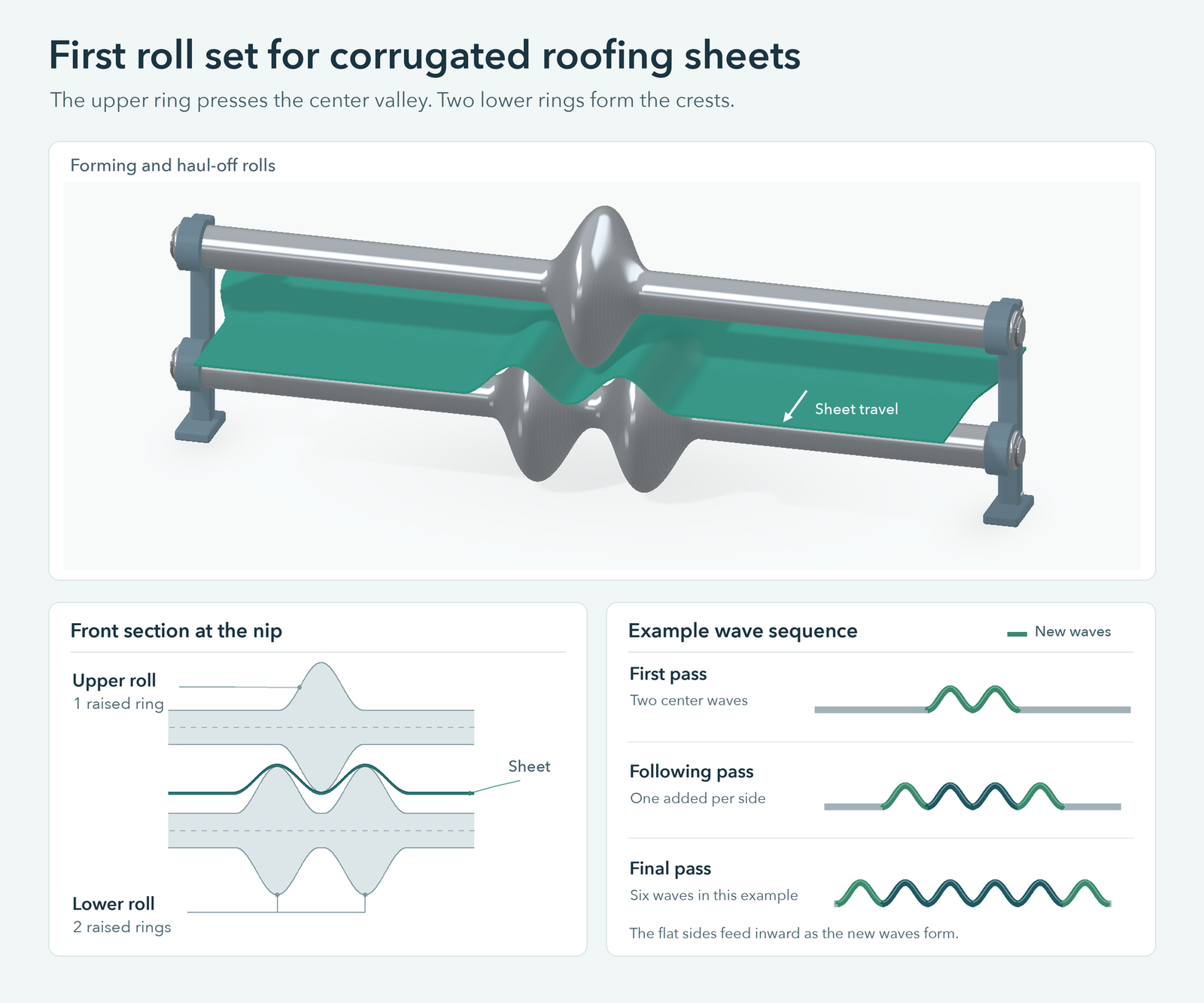
How the wave count grows from one roll set to the next
Take a six-wave sheet as an example. After the center pair takes shape, the next set adds one wave on each side. The final set forms the two outer waves. Look across the sheet after each set and you can see the corrugated section widen and the flat areas at the edges narrow.
The forming rolls also act as haul-off rolls. As they turn, they grip the warm sheet and pull it forward along the line while shaping the waves.
The required profile determines how many rolls and passes the line needs. Sheet width, thickness and production speed also affect the layout. For PVC corrugated roofing sheets, set the forming temperature and cooling to suit the compound and layer structure. The same sequence can be used for PP with settings matched to the PP sheet. Support the finished profile as it cools so it holds its shape through cutting.
Why the sheet starts with flat sides
Measure straight across from one crest to the next to get the wave pitch. Now follow the sheet down into the valley and back up to the next crest. That second path is longer. The rollers need that extra length across the sheet to form the wave.
The flat material on either side of the first pair can feed inward as later rolls form the next waves. In a single pass across the whole width, all the waves take shape at the same roll gap. If the guides restrict inward movement, the sheet can stretch unevenly and leave thin spots along the wave flanks. Uneven draw-in can also distort the profile or pull the sheet off center.
Checking the forming sequence and the finished sheet
When assessing a roofing sheet extrusion line, ask the supplier which waves each set of rolls forms and where the outer waves take shape. If you’re choosing a PVC roofing sheet making machine or a line for PP corrugated roofing sheets, check samples once the line is running steadily at your target output. Let the cut sheets cool before measuring them.
| Check | How to check it |
|---|---|
| Thickness | Measure the crests, flanks and valleys near both edges and in the center. Compare the lowest readings with your minimum thickness. |
| Wave height and pitch | Measure from crest to valley vertically and crest to crest horizontally. Compare the center waves with the outer ones and repeat the check on several sheets. |
| Width and side lap | Measure the overall width. Fit two sheets together at the overlap and measure the effective cover width. |
What to send with a roofing line inquiry
If you’re planning a line for plastic roofing sheets, send a cross-section drawing or a finished sample. Include the material, thickness, finished width, wave count, pitch, height and target output. Jiahao can use those details to review the die, roll sequence and cooling section together.
Browse Jiahao’s roofing sheet extrusion equipment or send your profile to Jiahao Machinery.
Discuss your production project
Share the product, material, dimensions, output target and factory conditions so the configuration can be reviewed.